


Previous Lowe Events
Thursday, Sept. 8, 2022
noon (MST) | Zoom
Łukasz Krzyżanowski
University of Ottawa

Learn the story of a largely forgotten group of Holocaust survivors who returned to their hometowns in provincial Poland and tried to start their lives anew. Focusing on Radom, an industrial city about 60 miles south of Warsaw, the story tells of the returnees facing new struggles along with massive political, social, and legal change. Survivors’ experiences provide important insights into the dynamics of post-genocide recovery. Drawing on a rare collection of documents—including the postwar Radom Jewish Committee records, discovered by the secret police in 1974—Krzyżanowski’s monograph, Ghost Citizens (2020) is the moving story of Holocaust survivors’ agency and their struggle to restore their lives in a place that was no longer home.
Thursday, Sept. 15, 2022
noon (MST) | Zoom
Katarzyna Person
Jewish Historical Institute, Warsaw

Explore the Jewish Order Service, commonly known as the Jewish Police, and its role in the daily life of the Warsaw ghetto. Learn how perception of the Jewish Police, and the narrative regarding its actions, changed during the existence of the ghetto and in the aftermath of the Holocaust.
Thursday, Sept. 22, 2022
5 p.m. (MST) | Zoom
Joanna Śliwa
Conference on Jewish Material Claims Against Germany

What do Jewish children’s recollections convey about the Holocaust in Kraków, Poland? Kraków had the fourth-largest Jewish population in prewar Poland, was the capital of German-occupied Poland, and is a thriving center of Jewish life today. In focusing on Jewish daily life and Polish-Jewish relations through the lens of Jewish children’s experiences, this talk expands beyond the story of Oskar Schindler and the over 1,000 Jews whom he saved from Kraków.
David Kertzer
Brown University
February 22, 2022
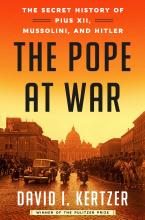
In October 16, 1943, German SS officers surprised over a thousand of Rome’s Jews in their homes and brought them to a military college a few hundred yards from the Vatican. Great controversy has surrounded what the pope did over the following two days before the Jews were loaded onto a train that would take them directly to Auschwitz. Based upon Vatican archives for the papacy of Pius XII — which were finally opened to scholars in 2020 — learn the complete, inside story for the first time.
purchase a copy of The Pope at War
Organized by ASU Jewish Studies. Sponsored by The Lowe Family Holocaust and Genocide Education Endowment in partnership with The Melikian Center for Russian, Eurasian and East European Studies.
Conference
Sunday, October 17, 2021
Since the rise of Islam in the seventh century, Jews and Muslims have lived in close proximity, collaborating, interacting and cross-influencing each other. This conference examines the development of Jewish-Muslim interaction over time, with special attention to the difference between pre-modern and modern periods, and highlighting the confluence of social, economic, political, cultural, and religious dimensions. The conference contends that understanding the past is conducive to addressing the challenges of the present and the future. World-renowned historians, sociologists and scholars of religious studies will examine the past and present of Jewish-Muslim relations.
organized by ASU Jewish Studies
sponsors
- Lowe Family Holocaust and Genocide Education Endowment
- Irving and Miriam Lowe Professor of Modern Judaism
in partnership with
January 25, 2021
The Lowe Family Research Workshop
Recent years have witnessed a dramatic rise in anti-Semitic incidents and the growth of anti-Semitic attitudes around the world. New research estimates more than a quarter of the world—1.09 billion people out of more than 4.1 billion people surveyed—harbors anti-Semitic attitudes. This workshop—organized by David Siroky and Lenka Bustikova of the School of Politics and Global Studies at Arizona State University—brings together leading scholars from around the globe to discuss the frontiers in the study of anti-Semitism and to debate critical factors that influence where and when ethnoreligious groups, and Jews in particular, are likely to be targeted and viewed with prejudice.
February 17, 2020
Federico Finchelstein
The New School for Social Research
Addressing the historical relationship between fascism and populism with a special focus on their similarities and differences vis-a-vis racism and antisemitism. If fascism (in countries like Germany and Italy) arrived to power by democratic means and then destroyed democracy from within and created extreme racist dictatorships; early post war-populists Latin American populists, like Getulio Vargas in Brazil and Peronism Argentina, were dictators that renounced dictatorships and racism, creating new populist democracies. This used to be a key distinction between populism and racism. And yet, in the new populism of the extreme right racism has returned making them closer to fascism than ever before.
Federico Finchelstein is Professor of History at the New School for Social Research and Eugene Lang College. He has taught at the History Department of Brown University and he received his PhD at Cornell University. He is Director of the Janey Program in Latin American Studies at NSSR, and the author of numerous books on fascism, populism, Dirty Wars, the Holocaust and Jewish history in Latin America and Europe. His books have been translated into Spanish, Italian, Portuguese, Chinese, Hungarian, Korean and Turkish.
March 18, 2019
Benjamin Nathans
University of Pennsylvania
The exodus of Jews from the former Soviet Union transformed the Jewish landscape on three continents and has been called the preeminent case of Jewish human rights activism. It is often identified — and confused — with the Soviet dissident movement and the struggle for rights in Russia. What brought the two movements together — and what kept them apart? This talk explores the ideas, the people, and the politics that animated the most consequential forms of resistance to the 20th century’s longest-lived experiment in totalitarian rule, and their consequences for the world today.
Benjamin Nathans is associate professor of history at the University of Pennsylvania, specializing in modern Russia, the Soviet Union, modern Jewish history, and the history of human rights. His multiple prizewinning book Beyond the Pale: The Jewish Encounter with Late Imperial Russia has been translated into Hebrew and Russian. He is currently completing a work titled To the Success of Our Hopeless Cause: A History of the Soviet Dissident Movement, and a co-edited volume, From Europe’s East to the Middle East: Israel’s Russian and Polish Lineages.
November 1, 2018
Yuri Slezkine
University of California, Berkeley
This lecture followed the lives of the original Bolsheviks from the time they joined the apocalyptic sect known as “the party of a new type” to the time most of them were arrested for terrorism and treason. It will focus on the connection between private lives and millenarian expectations and attempt to clarify the reasons for socialism’s premature demise.
Yuri Slezkine is the Jane K. Sather Professor of History at the University of California, Berkeley, and member of the American Academy of Arts and Sciences. His books include: The House of Government: A Saga of the Russian Revolution (Princeton University Press, 2017); The Jewish Century (Princeton University Press, 2004), which won the National Jewish Book Award; and Arctic Mirrors: Russian and the Small Peoples of the North (Cornell University Press), 1984. Slezkine has been a visiting lecturer at Oxford University and Vassar College, and has received fellowship support from the National Endowment for the Humanities (NEH), the John Simon Guggenheim Memorial Foundation, and the American Council of Learned Societies (ACLS), among others.